
By Voltage Controlled Oscillator 1752
What is a Voltage-Controlled Oscillator?
A Voltage-Controlled Oscillator (VCO) is an electronic oscillator. Its output signal frequency changes with the input control voltage, either linearly or in a set relation. As a key part of Phase-Locked Loops (PLL), Frequency Synthesizers, and Modulators/Demodulators, the VCO plays an important role in modern electronic systems. It changes voltage (an analog value) into frequency (a key parameter) and provides the base function for signal processing and control.
The main principle of a VCO is voltage-to-frequency conversion. It uses voltage-sensitive components. When the control voltage changes on a varactor diode (voltage-sensitive diode), its capacitance changes too. This change affects the resonance frequency of the oscillator circuit. In this way, voltage controls the output frequency exactly. This process makes a complete voltage-to-frequency modulation system.
A VCO usually has three basic parts:
When checking VCO performance, we look at these important parameters:
The VCO changes voltage into frequency. A varactor diode makes this possible. In reverse bias, its junction capacitance changes with bias voltage. This voltage-capacitance effect gives the physical base for frequency control. It allows exact control of frequency by changing voltage.
The LC-type VCO works in four main steps:
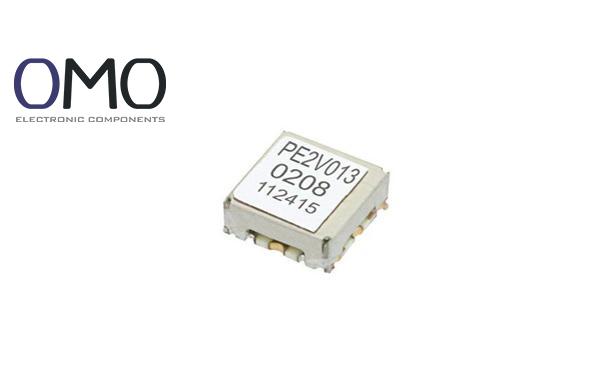
An LC-VCO uses an inductor and capacitor in a resonant circuit.
In practice, LC-VCO has better phase noise than others. For example, at 2 GHz, a good LC-VCO can reach −120 dBc/Hz @ 100 kHz offset. A ring oscillator often only reaches −90 dBc/Hz. This makes LC-VCO the best choice in systems like communication base stations.
A ring oscillator uses an odd number of inverters in a closed loop.
A crystal VCO uses a crystal resonator to set the frequency.
Comparison Table of VCO Types:
| Feature | LC-VCO | Ring Oscillator | Crystal VCXO |
| Phase Noise | Good | Normal | Very Good |
| Tuning Range | Medium | Wide | Very Narrow |
| Integration | Low | High | Medium |
| Cost | High | Low | High |
| Use Case | Wireless Comm. | Digital Circuits | Precision Tools |
The VCO is the controlled part in a PLL. Feedback makes its frequency lock to the reference. This ensures long-term stability and accuracy.
A VCO makes a set of stable and exact frequencies. This is the core of modern communication systems. Compared with old discrete circuits, modern integrated VCO synthesizers improve accuracy by over 3 times and reduce power use by 40%. This helps mobile devices become smaller and more efficient.
VCO has two roles here:
In fast digital systems, the VCO extracts the clock signal from received data. This ensures correct and reliable data transfer, especially in high-speed serial links.
In radar and measurement tools, the VCO makes exact scanning signals. For example, in a spectrum analyzer, the sweep source depends on a high-performance VCO. The linearity and stability of frequency scanning decide the accuracy of results.
Phase noise is one of the most important VCO factors. It affects signal-to-noise ratio (SNR) and bit error rate (BER). It is shown in dBc/Hz and measured with a spectrum analyzer. Low phase noise means cleaner signals, which is critical in modern dense-frequency systems.
The tuning range shows how wide the VCO can cover frequencies. Linearity affects control accuracy and circuit design. Designers must balance between wide range and high linearity. They must also add temperature compensation. Modern VCOs with new compensation reduce frequency drift by more than 50%. This improves reliability in harsh environments.
Low power is very important, especially in battery devices. Low power use makes longer use time and less heat. Modern VCOs use dynamic bias and multi-mode operation to balance power and performance.
PSRR shows how sensitive the VCO is to supply voltage changes. A high PSRR means better resistance to power noise. This is important in systems with complex power supplies.
In IC design, chip size affects cost. Designers must balance performance and price. With new technology, modern VCOs get smaller while keeping good performance.
The oscillation frequency of a voltage-controlled oscillator is governed by the voltage applied to its input.
A voltage-controlled oscillator (VCO) allows its output frequency to be varied by an input voltage. This functionality makes it an essential part of many RF and microwave technologies, such as those found in radio equipment, radar systems, and wireless communications.
Oscillators generally produce a stable periodic signal at a set frequency using built-in components, which is optimal for applications like clocks that demand consistent timing. On the other hand, a voltage-controlled oscillator (VCO) adjusts its output frequency in response to an external voltage input, thereby facilitating dynamic operations such as frequency modulation, tuning adaptation, and variable signal synthesis.
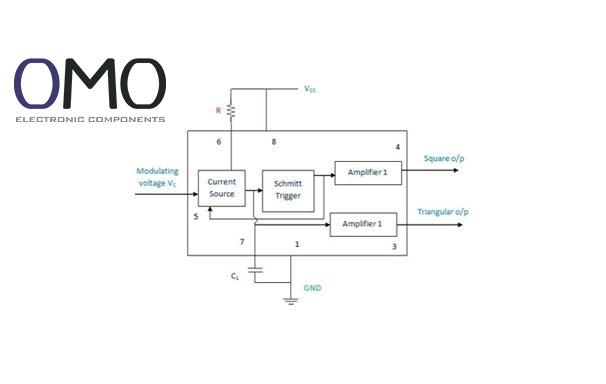
The operation of a relaxation oscillator is based on repeatedly charging and discharging a capacitor through a resistor. This cycle continues each time a specific voltage level is attained, resulting in the generation of non-sinusoidal waveforms (e.g., square or triangular waves).