
By Kilo Ohms To Ohms 7467
Conversion Between Ohm and Kiloohm
Common Mistakes and How to Avoid Them
Extended Resistance Units and Conversion
The Ohm (Ω) is the standard unit of resistance in the International System of Units (SI).
Its scientific definition: When a conductor has 1 volt (V) applied across its ends and produces 1 ampere (A) of current, the resistance of that conductor is 1 Ohm (Ω).
The unit name comes from German physicist Georg Simon Ohm, to honor his contribution to circuit theory.
Resistance shows how a material blocks current. It is a core parameter in circuit analysis.
The symbol of Ohm is the Greek letter Ω (Omega).
It is a derived unit from volt (V) and ampere (A).
In practice, you can calculate resistance with the formula:
R = V / I (Ohm’s Law)
This simple but powerful relation is the foundation of circuit analysis.
Materials can be grouped by resistivity:
The Kiloohm (kΩ) is a decimal multiple of the Ohm. The prefix “Kilo” means 1000 (10³).
So, 1 Kiloohm = 1000 Ohms.
This system is the same as other SI units and makes engineering calculations easier.
The correct symbol is kΩ (lowercase k + uppercase Ω).
You will see it in circuit diagrams, component lists, and technical papers.
Using kΩ avoids long numbers with many zeros. It makes reading and writing data faster and reduces mistakes.
In practical electronics, kΩ is one of the most common resistance units.
Typical resistors range from hundreds of Ohms to several Megaohms (MΩ).
The kΩ unit keeps values in a clear range (0.1–1000 kΩ).
Examples:
This style is short and standard in engineering.
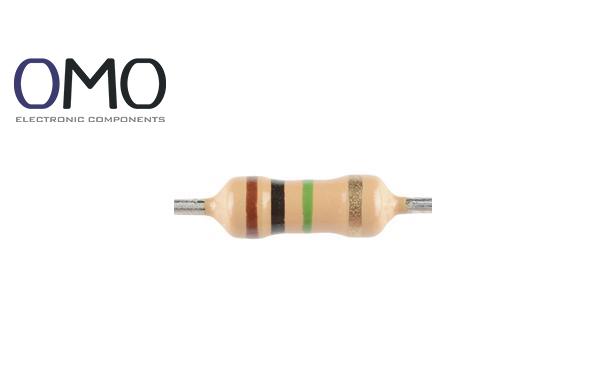
The conversion follows the decimal system:
1 kΩ = 1000 Ω
| Ohm (Ω) | Kiloohm (kΩ) | Example Application |
| 1 | 0.001 | Wire resistance |
| 10 | 0.01 | Sampling resistor |
| 100 | 0.1 | Small limiter |
| 1,000 | 1 | Standard resistor |
| 10,000 | 10 | Pull-up resistor |
| 100,000 | 100 | Bias resistor |
| 1,000,000 | 1,000 | High-resistance circuit |
Example:
3.3 kΩ = 3300 Ω
5600 Ω = 5.6 kΩ
Low resistances (1–100 Ω) are important in:
kΩ resistors are widely used in circuits:
High-precision metal film resistors (±0.1%) work better than carbon film in voltage dividers. They give better stability and performance.
In formulas like P = I²R, always unify units first.
If current is in mA and resistance in kΩ, convert them to A and Ω before calculation.
Modern digital meters with auto-range help prevent these errors.
| Original | In Ohm (Ω) | In kΩ | In MΩ |
| 1 mΩ | 0.001 | 1×10⁻⁶ | 1×10⁻⁹ |
| 1 Ω | 1 | 0.001 | 1×10⁻⁶ |
| 1 kΩ | 1000 | 1 | 0.001 |
| 1 MΩ | 1,000,000 | 1000 | 1 |
| 10 MΩ | 10,000,000 | 10,000 | 10 |
The conversion from ohms (Ω) to kilo-ohms (kΩ) is done by dividing the value by 1,000. As an example, a resistance of 5,000 Ω is equivalent to 5 kΩ.
The term "1k ohm" denotes 1,000 ohms, as the prefix "kilo-" represents a factor of one thousand.
The term "kilo-ohm" (abbreviated kΩ or sometimes simply k) represents a value of 1,000 ohms. This unit of measurement is commonplace in electronics and electrical engineering contexts.
Electrical resistance is measured in ohms (Ω). One ohm is the amount of resistance that allows a current of one ampere to flow when a voltage of one volt is applied. Consequently, a circuit with lower resistance (fewer ohms) will allow more current to flow.