
By AA vs AAA vs AAAA Battery Differences 11478
Application Scenarios of AA, AAA, and AAAA Batteries
AA, AAA, AAAA Performance Comparison
The AA battery (also called No. 5 battery) is a type of cylindrical dry battery defined in the International Electrotechnical Commission (IEC) standard. Its history goes back to the 20th century, when battery size standards were unified. With its balanced size and performance, the AA battery quickly became an essential energy source for home electronics. Almost every household has them.
| Feature | Value / Type | Notes |
| Size | ~ Ø14.5 mm × H50.5 mm | IEC R6 (LR6, FR6) standard |
| Weight (alkaline) | ~ 23 g | Carbon-zinc is lighter |
| Nominal voltage | 1.5 V (new battery) | Same for alkaline/carbon-zinc |
| Capacity (alkaline) | 2000–3000 mAh | Depends on brand |
| Common chemistry | Alkaline, NiMH (nickel–metal hydride), Li (lithium) | Carbon-zinc is cheapest but short life |
The main advantage of AA batteries is their strong power with wide application. In common 200–500 mA use (such as toys), alkaline AA batteries often last 50%–80% longer than alkaline AAA batteries of the same brand. Their larger volume holds more chemical material, giving more power and longer life, reducing the need for frequent replacement.
The AAA battery (also called No. 7 battery) is slimmer and smaller than an AA battery. It also belongs to the IEC standard system (such as IEC R03 or LR03). It was designed to meet the demand for portable and compact devices, where space and weight are important.
| Feature | Value / Type | Notes |
| Size | ~ Ø10.5 mm × H44.5 mm | IEC R03 (LR03, FR03) standard |
| Weight (alkaline) | ~ 11 g | |
| Nominal voltage | 1.5 V (new battery) | |
| Capacity (alkaline) | 800–1200 mAh | Lower than AA |
| Common chemistry | Alkaline, NiMH, Li |
The main value of AAA batteries is portability and space saving. For example, a wireless mouse using 1 or 2 AAA batteries is lighter than one using AA batteries, making it 25%–40% lighter and more comfortable for long use. In portable tools, every gram saved is important.
The AAAA battery is the slimmest among the three types. It usually follows the IEC R8LR41 standard (also called 25A). It is less common than AA or AAA, and is used mainly in devices with extreme space limits.
| Feature | Value / Type | Notes |
| Size | ~ Ø8.3 mm × H42.5 mm | IEC R8LR41 standard |
| Weight (alkaline) | ~ 6 g | |
| Nominal voltage | 1.5 V (new battery) | |
| Capacity (alkaline) | 400–600 mAh | About 15%–25% of AA |
| Common chemistry | Mostly alkaline | Rechargeable/lithium are rare and costly |
The biggest advantage of AAAA batteries is their fit for very thin devices where AA or AAA cannot work. For example, a slim electronic pen (less than 10 mm thick) can use AAAA batteries without breaking its slim design.
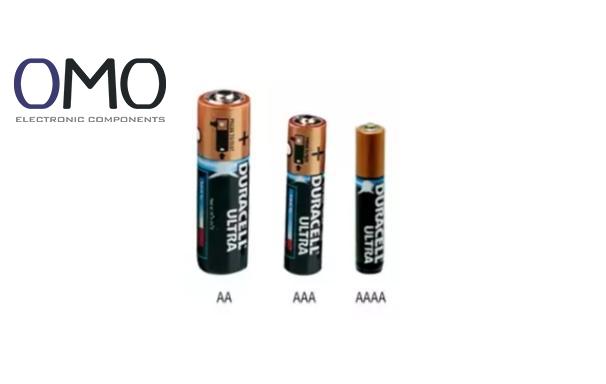
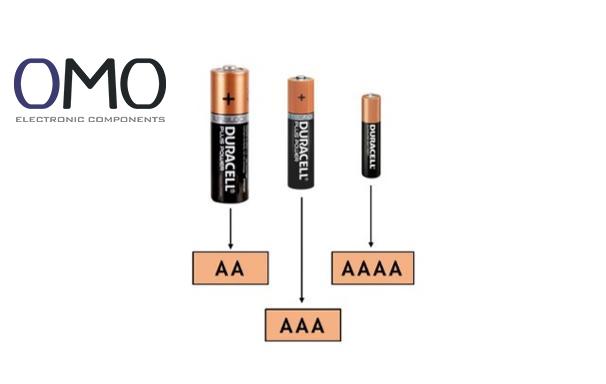
| Comparison Item | AA Battery | AAA Battery | AAAA Battery | Summary |
| Size | ~ Ø14.5 mm × 50.5 mm | ~ Ø10.5 mm × 44.5 mm | ~ Ø8.3 mm × 42.5 mm | Size order: AA > AAA > AAAA |
| Weight (alkaline) | ~ 23 g | ~ 11 g | ~ 6 g | Weight order: AA > AAA > AAAA |
| Nominal voltage | 1.5 V | 1.5 V | 1.5 V | Same voltage, check device needs |
| Capacity (alkaline) | 2000–3000 mAh | 800–1200 mAh | 400–600 mAh | AA has biggest energy storage |
| Current range | Medium (~100–500 mA+) | Low (~50–200 mA) | Very low (<100 mA) | Power: AA > AAA > AAAA |
| Expected life | Long | Medium | Short | AA lasts longest in same device |
| Rechargeable options | Many (NiMH common) | Common (NiMH) | Very few | AA, AAA better for eco & cost |
| Market popularity | Very high | High | Low | AA, AAA easy to buy, AAAA for niche |
The AAAA 1.5V battery is designed for small, low-power electronics, including compact items like laser pointers, penlights, and select Bluetooth headsets, as well as specialized devices such as hearing aid remotes and certain gaming controllers.
While a standard AA battery provides a nominal voltage of 1.5 volts, rechargeable AA varieties typically operate at a lower nominal voltage of 1.2 volts. The actual voltage delivered by any AA battery is subject to variation due to factors like its chemistry, age, and usage level, falling within an approximate range of 1.2V to 1.6V.
The longevity of AAA batteries depends on their type. Alkaline AAAs, the standard type, usually function for 3 to 5 years under ordinary conditions. In contrast, lithium-based AAAs often exceed 10 years of service life owing to minimal self-discharge. For rechargeable AAAs, they typically withstand 500 to 1000 recharge cycles, meaning about 2-3 years with regular use.
Although AAA batteries are smaller than AA batteries, they cost more. This is mainly because they require greater manufacturing precision, different regional demand, and their chemistry type (such as alkaline vs. lithium).