
By ON Semiconductor / Fairchild 9372
Ⅰ. Introduction of S8050 and 2N2222
S8050: It is a low-power NPN transistor, which is often used in low-power amplification and switching circuits. Its current flows from the emitter (E) to the collector (C). The maximum collector current (IC) of the S8050 is usually around 100mA, while the maximum collector-base voltage (VCEO) is usually around 40V.
2N2222: It is a common NPN type low-power transistor, which is also commonly used in low-power amplification and switching circuits. Its current also flows from the emitter (E) to the collector (C). The maximum collector current (IC) of 2N2222 is usually around 800mA, while the maximum collector-base voltage (VCEO) is usually around 30V.
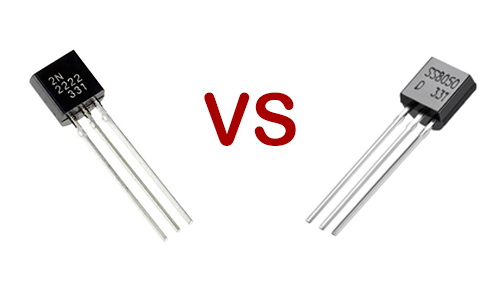
Ⅱ. The joint effect of S8050 and 2N2222
1. Signal amplification: Both S8050 and 2N2222 can be used in small signal amplifiers to amplify weak input signals to larger amplitudes for further processing or transmission.Transistor Output Optocouplers
2. Current amplification: Both S8050 and 2N2222 can be used as a part of the current amplifier to amplify the current signal to meet specific application requirements.
3. Switch control: Both transistors are suitable for switching circuits, which can control the switching status of other circuits or devices, such as LED lights, relays, etc.
4. Sensor interface: In the sensor interface circuit, both transistors can be used to amplify and process the weak signal generated by the sensor.
5. DIY Projects: These two types of transistors also find their place in various DIY electronics projects for building various electronic gadgets and toys.
Ⅲ. The difference between S8050 and 2N2222
1. Differences in electrical performance parameters:
S8050 and 2N2222 may have different electrical performance parameters such as maximum current, voltage, and power withstand capability. These parameters affect how well a transistor can be used in different applications.
The maximum collector current of S8050 is usually around 100mA, while that of 2N2222 is usually around 800mA. Therefore, the 2N2222 may be more suitable in applications that handle higher currents. The high frequency performance of S8050 and 2N2222 may be slightly different due to the difference in the internal structure and materials of the transistors. In high frequency applications, this may affect its operation.
Current amplification indicates how well a transistor amplifies an input current to an output current. The hFE value of S8050 and 2N2222 may be different, which will affect the performance of the amplifier circuit.
2. The difference in packaging:
Other Package Types: Besides TO-92 package, S8050 and 2N2222 may also be available in other package types like SOT-23 etc. Different package types may have different effects on board layout and thermal performance.
TO-92 package: This is a common small package, both the S8050 and 2N2222 can usually be found in the TO-92 package. This package is suitable for many low power applications because it is small, easy to mount, and suitable for hand soldering.
Thermal performance: Transistors of different package types may have different thermal performance. Some packages may be better suited for high power applications because they dissipate heat better.
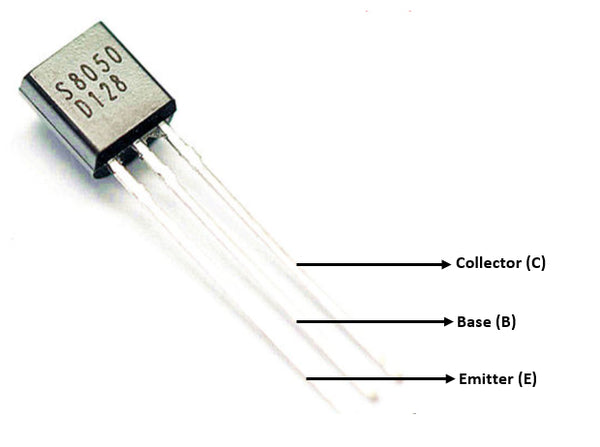
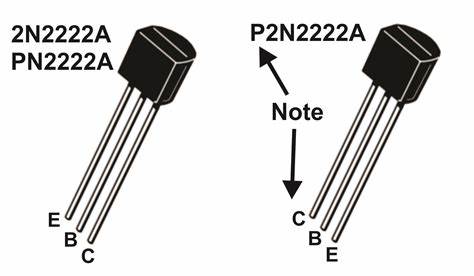
Pinout: Different package types may have different pinouts, which can affect how they are mounted and laid out on the board.
3. The difference in temperature performance:
Operating Range: Each transistor has its recommended operating temperature range. The operating temperature range of the S8050 and 2N2222 may be different. When selecting transistors, you need to make sure they have the right operating temperature range for your application.
Temperature coefficient: The electrical performance parameters of each transistor (such as current magnification, saturation current, etc.) may change with temperature. The S8050 and 2N2222 may have slightly different temperature coefficients, which may affect their performance at different temperatures.
Temperature Drift: Temperature changes can cause drift in electrical performance parameters, which can affect circuit stability and performance.
Thermal Stability: Some transistors may exhibit better thermal stability at high temperatures, while others may degrade faster at high temperatures. Therefore, it is also necessary to consider whether the application will face a high temperature environment, and select a suitable transistor to ensure stability.
4. Differences in application fields:
The main application fields of S8050:
Signal generator: In some simple signal generators, S8050 can be used to generate basic signal waveforms.
Sensor interface: Due to its low power characteristics, S8050 can be used to amplify and process the weak signal generated by the sensor.
Low Power Amplifier: Since S8050 is a small power transistor, it is suitable for low power amplifying circuits, such as small audio amplifiers or signal amplifiers.
Signal conditioning: S8050 can be used to adjust the amplitude or frequency of a signal, for example in some modulation circuits.
The main application fields of 2N2222:
Sensor Interface: The 2N2222 can also be used in sensor interface circuits, especially when the sensor signal needs to be amplified.
Switching circuit: 2N2222 can be used in low to medium power switching circuits to control the switching status of other circuits or devices, such as LED lights, relays, etc.
Signal Amplifier: Due to the higher current and voltage capabilities of the 2N2222, it is more suitable as a small power signal amplifier.
Signal conditioning: 2N2222 can be used to adjust the amplitude or frequency of the signal, suitable for some specific applications.
Current Amplification: Due to its high current handling capability, the 2N2222 is suitable for applications requiring amplified current signals.
Ⅳ. Advantages of S8050 and 2N2222
1. S8050: S8050 is a low-power transistor, suitable for low-power applications, such as small amplifiers, signal amplifiers, etc. Because of its low power characteristics, S8050 is usually cheaper and suitable for circuit design with higher economical requirements.
2. 2N2222: The 2N2222 typically has a higher maximum collector current and maximum collector-base voltage, giving it an advantage in slightly higher power applications. Due to its higher current capability, the 2N2222 has certain advantages in signal amplification applications. The performance of 2N2222 may be more stable in some aspects, suitable for some applications that require higher stability.
Ⅴ. Is the working principle of S8050 and 2N2222 the same?
Both S8050 and 2N2222 are NPN type low-power transistors, so their working principles are basically the same. They all have a similar structure, which includes Emitter, Base, and Collector. In an NPN transistor, the emitter and base are N-type regions while the collector is a P-type region.
Working principle:
Forward Bias: When a forward voltage is applied across the emitter-base junction, the N-type region of the emitter becomes high potential and the N-type region of the base becomes low potential. This makes the emitter-base junction into a forward biased state.
Emitter Current: When the emitter voltage becomes forward biased, the emitter-base junction becomes conductive, allowing electrons to flow from the emitter to the base. This induces an emitter current (IE) whose magnitude is controlled by the base current (IB).
Collector Current: Base current causes collector current (IC) to flow. Due to the amplification characteristics of the transistor, IC is much larger than IB, thus realizing the amplification of the current signal.
Base Current: When the emitter-base junction is turned on, electrons flow to the base, which causes the base current (IB). The presence of base current allows the transistor to be amplified and controlled.
Saturation and Cutoff: When the base current is large enough, the transistor enters the saturation region where the collector current is almost no longer affected by the base current. On the contrary, when the base current is very small, the transistor will enter the cut-off region, and its collector current is very small.
Amplification: When a small current flows through the base, it causes a significant increase in the collector current due to the amplifying nature of the transistor. This makes the transistor crucial in amplifying the signal.
Ⅵ .In the amplifier circuit, what is the difference between using S8050 and 2N2222?
1. Maximum current and voltage: 2N2222 usually has higher maximum current and lower maximum voltage capability. In the case where higher current amplification is required, 2N2222 is more suitable. Care should be taken not to exceed its maximum current and voltage limits.
2. Magnification: Since the current magnification (hFE) of S8050 and 2N2222 are different, using them in the same circuit will result in different amplification effects. A higher hFE value means the transistor can amplify the input signal more, but can also cause instability issues.
3. Stability: Due to differences in electrical performance parameters and characteristics, the stability of transistors may vary. Higher magnifications may cause circuits to be more susceptible to interference or instability.
4. Frequency response: Since S8050 and 2N2222 may have different high-frequency characteristics, their effects in high-frequency amplifying circuits are different. Some applications require consideration of the frequency response of the transistor.
5. Power consumption: Because the current and voltage capabilities of S8050 and 2N2222 are different, their power consumption will be different. This affects the thermal characteristics and cooling requirements of the circuit.
Ⅶ.S8050 and 2N2222 which transistor has lower noise characteristics
2N2222 will be better in terms of noise characteristics. Because it is a general-purpose low-power NPN transistor, it is often used in amplification and switching circuits, and it usually has certain advantages in noise performance.
The actual noise characteristics depend on several factors, including the transistor manufacturing process, package type, operating conditions, etc. Noise characteristics are generally more critical in low noise applications such as high impedance amplifiers.
Ⅷ. What is the difference between the maximum power capacity of S8050 and 2N2222?
S8050 and 2N2222 are two different types of low-power transistors, and their maximum power handling capacity will be different. Maximum power handling capability refers to the ability of a transistor to operate without exceeding its specified maximum current and voltage.
S8050:
Generally speaking, the S8050 is a low-power transistor, and its maximum power handling capability is usually in the range of several hundred milliwatts (mW). This means it is suitable for low power circuits and applications.
2N2222:
Similar to the S8050, the 2N2222 is also a low power transistor, but it usually has a slightly higher maximum power handling capability. The exact maximum power handling capability will also vary by model and manufacturer, but is usually in the range of a few hundred milliwatts to 1 watt.
Frequently Asked Questions
1. What is the equivalent of S8050?
The transistor equivalent of the S8050 transistor is S9013, S9014, 2n5551, 2n5830, mps6602, mpsw01ag.
2. Can 2N2222 be used instead of BC547?
The 2N2222 and BC547 transistors are general-purpose transistors commonly used in circuits; the BC547 transistor is one of the best transistors of its kind and is interchangeable with the 2N2222 transistor.
3. What is the gain of the S8050 transistor?
The S8050 transistor is an NPN transistor with an excellent maximum gain capability of 400, but a normal gain of about 110, so you can use it for amplifier applications. It has a maximum collector current of 700mA and a maximum collector power dissipation of 2W.
4. What is the minimum voltage of 2N2222?
The base-emitter saturation voltage of the 2N2222 is typically 1.3 volts 15 mA. When the collector current exceeds 500 mA, the base optimum trigger voltage becomes 2.6 V. For the 2N2222A, these numbers are 1.2 volts and 2 volts respectively.